NODO
From public experience to operational software.
I designed and built NODO as a connected product ecosystem for local businesses: a public website, a guided configurator, an internal CRM and the data foundations between them.
One customer journey.
One connected product.
Three product surfaces share a clear handoff, from a business’s first question to the work that follows.
The public website introduces the service, then a guided configurator collects a business’s choices and prepares a structured request.
Make the handoff between people and systems feel natural.
Two audiences, one system.
From open need to structured work.
Engineering is part of the product decision.
The public surface makes the product understandable.
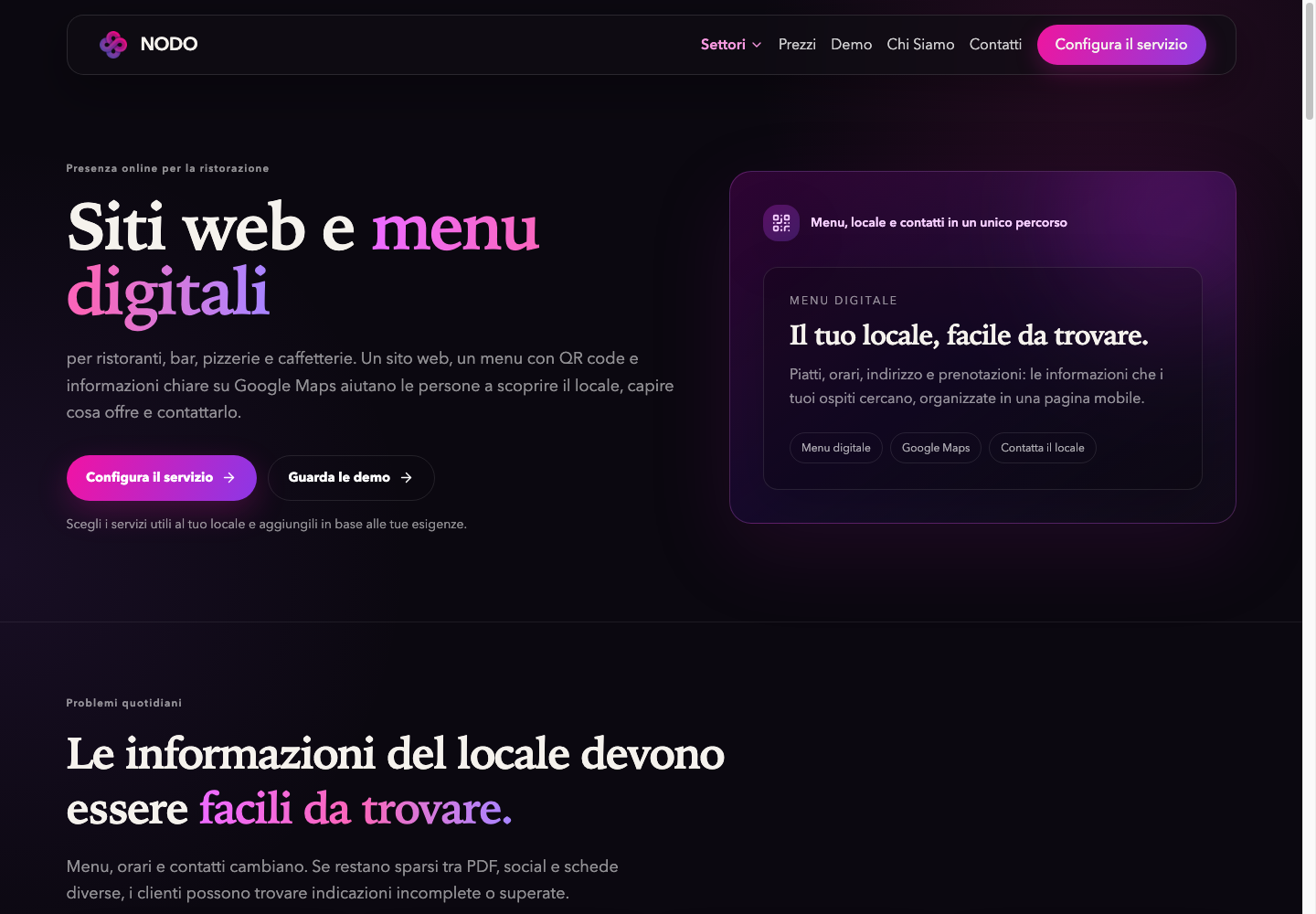
Lead with clarity before asking for a commitment.
The public NODO website is structured around market-aware content, service discovery and clear paths into pricing, evaluation and configuration. The engineering challenge is the same as the design challenge: keep the system flexible enough for multiple markets without making the experience feel assembled.
Six steps. A flow that responds to the customer.
The public configurator carries customers from choosing a website and related services to a reviewable configuration. Its UI uses conditional questions, validation, saved draft state, a summary and a request handoff.
Progressive disclosure, built into the journey.
Public interface labels verified
Does the customer need an additional capability?
The answer can reveal relevant follow-up questions or keep the path focused. The full decision tree is not shown.
A simplified example; the complete rules are intentionally omitted.
Captured from the local application using synthetic, unsaved answers. The original interface is shown in Italian; no customer data or commercial calculations are included.
A request becomes coordinated work.
The CRM preserves context after the public handoff.
The authenticated workspace connects business records, website requests, tasks, communication and settings. The diagram shows the broad collaboration model, without reproducing the internal pipeline or customer data.
From a request to coordinated work.
Responsibilities move across people and product. The labels describe broad roles, not the private sales pipeline.
Customer intent is carried forward as useful context; the operational model stays private.
One owner across the product lifecycle.
Select a stage to see how the work connects.
Set the product direction and audience.
Product surfaces, application logic and data move together.
Connected layers.
Clear boundaries.
A high-level view of the technologies verified across the public application and CRM repositories. It describes responsibility areas without exposing implementation details.
Digital interactions support the service lifecycle; this journey is separate from the configurator flow and CRM coordination model.
A working ecosystem built from scratch.
NODO is the clearest example of my Product Engineer positioning: a product where the experience, the system and the implementation have to make sense together.
This public case study intentionally abstracts commercial logic, internal endpoints, customer data, schema details and operational playbooks. The goal is to show the product thinking and engineering scope without making the private system reproducible.